 Changelly
 supports fixed or floating crypto swaps and partner-operated purchases and sales
Changelly lets you exchange cryptocurrency, buy it with traditional money, or sell it through payment providers. Standard swaps send the exchanged asset to a receiving wallet, with fixed or floating rate options. Buying and selling involve a provider's payment methods, eligibility rules, and verification requirements. DeFi swaps offer another way to exchange supported assets through wallet authorization. Your starting funds and intended destination determine which service fits the transaction.
Prepare the receiving wallet before funding a swap
A standard exchange needs a supported currency pair and a receiving address compatible with the chosen output network. The destination wallet must accept that exact asset on that network. Matching the currency name alone doesn't establish compatibility, because assets can exist on different blockchains.
The exchange order specifies the input asset, amount, and deposit address. It also records where the output should go. Review those details before sending funds, including any memo or destination tag that the receiving service requires. These extra identifiers can direct a payment to the correct account within a shared address.
Changelly processes the incoming cryptocurrency and sends the exchanged asset to the recipient address. Account access doesn't replace a receiving wallet. The standard exchange service requires you to supply the destination, so preparing it belongs before payment, especially when another exchange will receive the funds.
A successful, confirmed outgoing transfer provides evidence of delivery. Its transaction hash identifies the blockchain record, where the destination and transfer details can be checked. A receiving exchange may still need confirmations before crediting an account. Keep the order identifier separate from the blockchain hash: they identify different records and help resolve different questions.
Should you choose a fixed or floating rate?
Choose a fixed quote when you need a stated output and can meet its payment conditions. A floating quote allows the output to change with market movements during processing. Neither option makes an unsupported network acceptable or removes the possibility of a compliance hold.
The fixed option depends on the amount that reaches the deposit address and the order's payment deadline. A withdrawal fee deducted by the sending service can leave the deposit short. Check the actual amount that will arrive before authorizing the transfer. The following parameters apply to standard exchange orders; they aren't universal rules for fiat purchases or DeFi swaps.
| Standard exchange parameter | Required value or failure condition |
|---|---|
| Fixed-quote deposit amount | The amount received must match the order; a short deposit can prevent execution under the quote. |
| Payment deadline | The deadline belongs to the selected order and rate mode; late payment can require manual handling. |
| Deposit address reuse | The generated address belongs to one transaction; sending again doesn't create another valid order. |
| Input network | The transfer must use the network specified for the input asset; an incompatible transfer may be unrecoverable. |
| Execution boundary | A quote applies to its own payment instructions, not every transfer of the same cryptocurrency. |
Buying crypto with a card or bank transfer
When your starting funds are traditional money, the purchase marketplace presents offers from payment providers. Select the cryptocurrency, payment currency, and amount before comparing the available offers. Each provider supports its own combination of locations, payment methods, and purchase limits.
Payment providers process the fiat purchases available through Changelly's marketplace. A purchase may continue on the provider's checkout. Direct Buy supports purchases within the Changelly interface, while a payment partner still handles processing. Staying on the same screen doesn't make every purchase subject to identical terms.
Compare the amount of cryptocurrency that the offer delivers for the same payment amount. Purchase fees and payment conditions affect that comparison. A card payment and a bank transfer can also have different processing times, so a quoted delivery estimate needs the context of the chosen method.
Keep the provider's purchase confirmation. It identifies the party handling the payment and provides details needed if the crypto doesn't arrive. Bank authorization alone doesn't establish cryptocurrency delivery; the payout transaction and the receiving wallet provide that evidence.
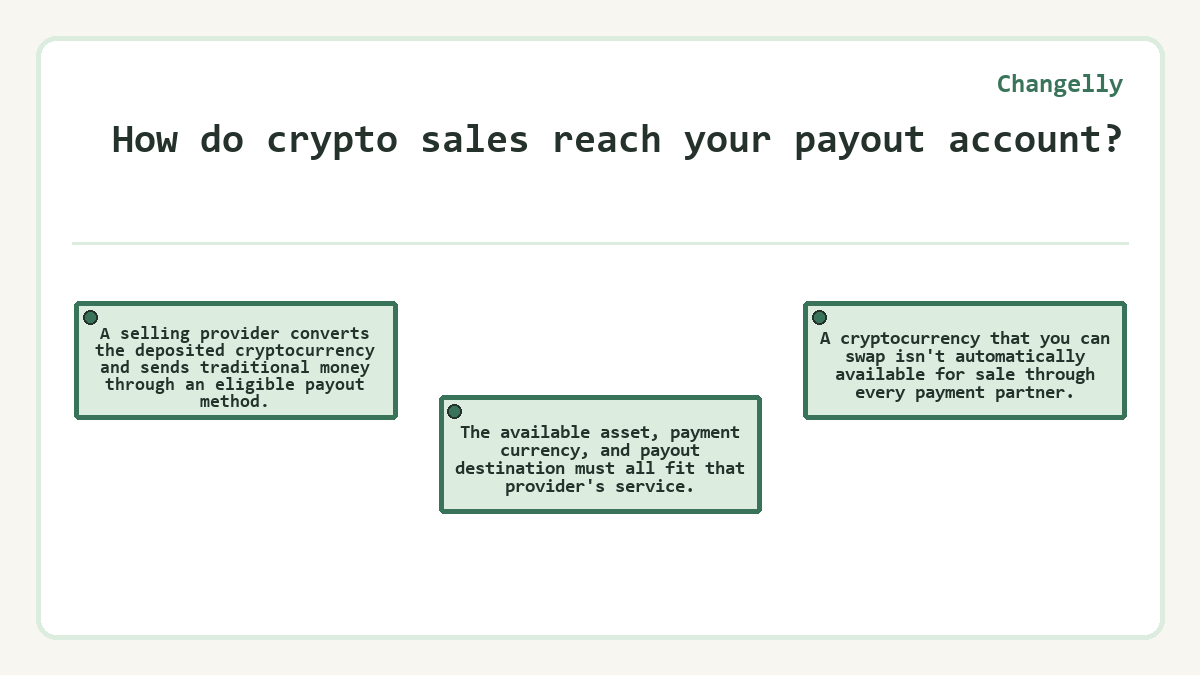
How do crypto sales reach your payout account?
A selling provider converts the deposited cryptocurrency and sends traditional money through an eligible payout method. The available asset, payment currency, and payout destination must all fit that provider's service. A cryptocurrency that you can swap isn't automatically available for sale through every payment partner.
Review the payout method and identity requirements before depositing cryptocurrency. Selling involves both a blockchain transfer and a separate payment to the destination account. The deposit reaching the provider establishes receipt of the crypto, while the account credit establishes receipt of the sale proceeds. Those events can occur at different times. Keep the selling order's details because its provider handles payout questions.
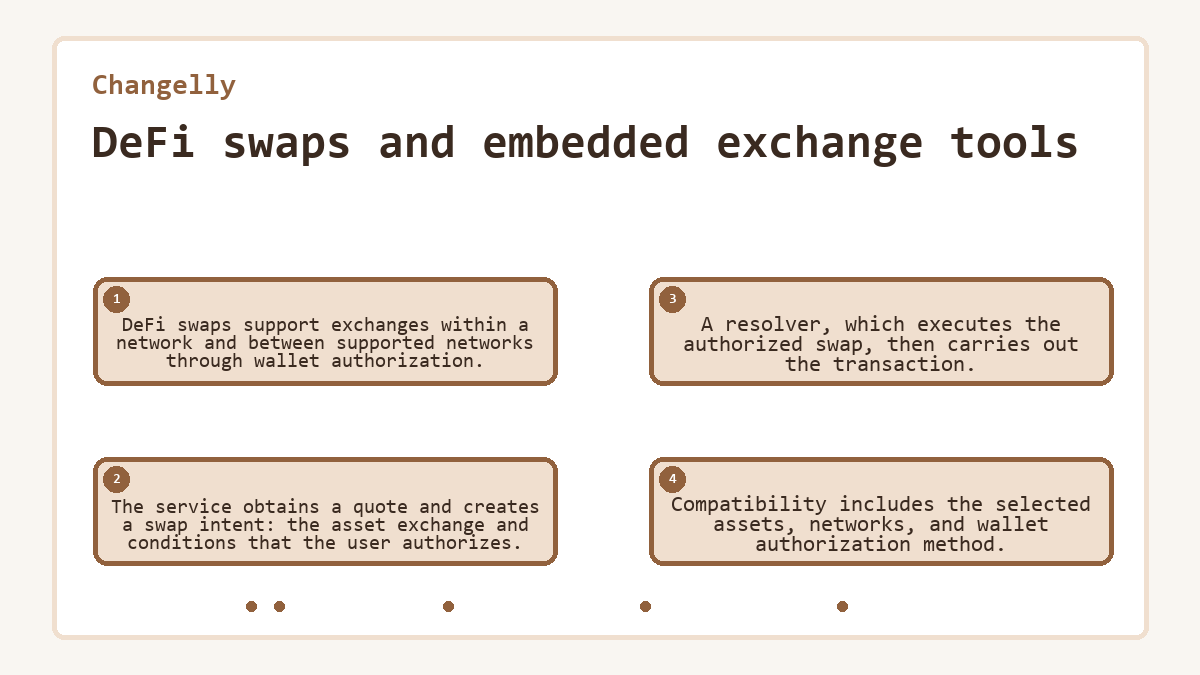
DeFi swaps and embedded exchange tools
DeFi swaps support exchanges within a network and between supported networks through wallet authorization. The service obtains a quote and creates a swap intent: the asset exchange and conditions that the user authorizes. A resolver, which executes the authorized swap, then carries out the transaction. Compatibility includes the selected assets, networks, and wallet authorization method.
A wallet signature authorizes the specified operation; it doesn't prove that execution has finished. The DeFi system reports swap status and, once available, the destination transaction hash. Use that hash to check receipt of the output asset and amount on the destination network. This option suits an exchange that has a supported DeFi route and a compatible wallet. It doesn't supply a bank payout or replace the purchase provider needed to spend traditional money.
Exchange functions can also appear inside other products through an API, a software interface that connects services. Changelly provides exchange and fiat integration tools for businesses, alongside its consumer services. An embedded exchange can therefore involve the wallet application, exchange processor, and payment provider in different roles. Identify which service handles the particular transaction before relying on the surrounding application's account or support features.
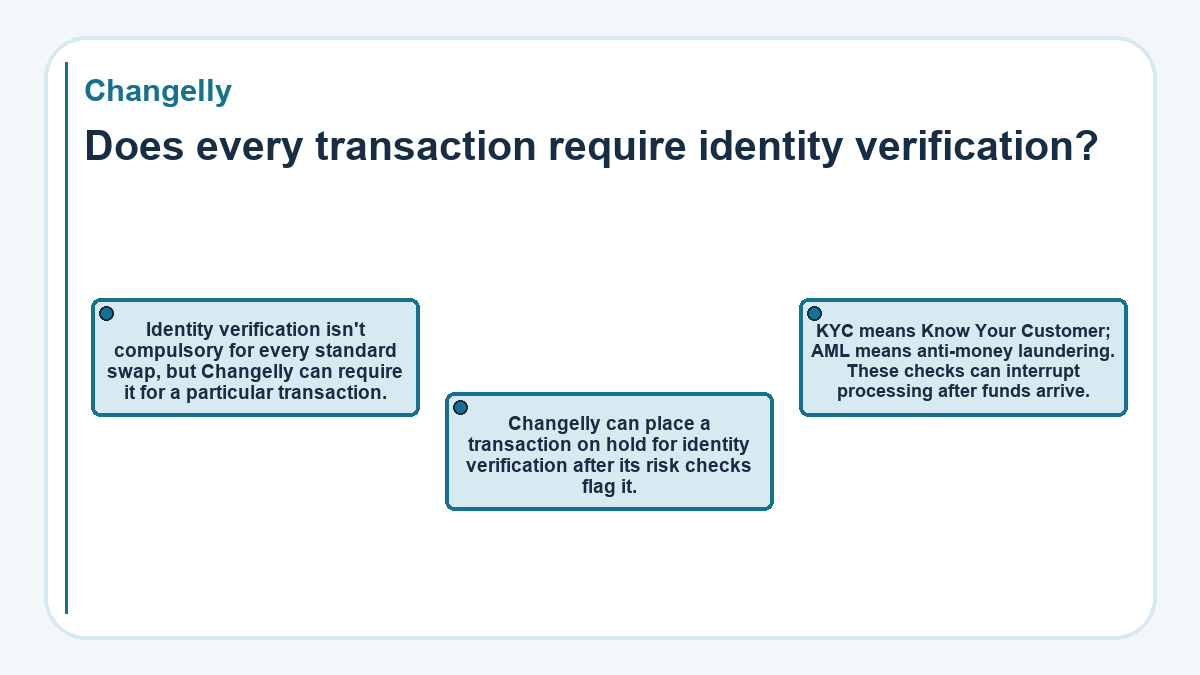
Does every transaction require identity verification?
Identity verification isn't compulsory for every standard swap, but Changelly can require it for a particular transaction. Changelly can place a transaction on hold for identity verification after its risk checks flag it. KYC means Know Your Customer; AML means anti-money laundering. These checks can interrupt processing after funds arrive.
A request may involve an identity document, a face check, or evidence of the funds' origin. The exact request determines what you need to provide. An earlier successful verification doesn't rule out additional questions. Purchase and selling providers apply their own verification requirements, so approval for one service doesn't establish approval for another. Decide whether you can meet those requirements before transferring funds.
Cancellation limits before you commit funds
Once a standard exchange has a payout hash, Changelly says it can't cancel the transaction. Before payout, support may be able to intervene, but stopping an exchange or recovering funds isn't assured. Refund possibilities depend on the error, processing stage, and applicable fees. If the destination or payment instructions don't fit your intended transaction, leave it unfunded and resolve that mismatch before choosing whether to proceed.
Changelly: questions and answers
-
What is the minimum amount for a Changelly swap?
- The minimum depends on the selected exchange pair and the quote available for that transaction. It isn't one permanent amount for every cryptocurrency. Check the minimum shown for your selection before funding the order. Sending less can prevent automatic processing, and a very small deposit may not cover the network cost of a refund.
-
Is Changelly available in every country?
- Changelly restricts access in specified locations, and payment providers have their own geographic restrictions. Availability of the website doesn't establish eligibility to transact. The service's restrictions can concern location, nationality, or residence, while a payment offer also depends on the provider's coverage. A supported payment currency alone doesn't establish that a purchase is available to you.
-
Does Changelly offer an app for buying and selling crypto?
- Changelly has apps for iOS and Android that support cryptocurrency purchases, sales, and exchanges. The app also provides transaction history and access to support. Using the app doesn't remove the conditions attached to the selected service, including supported assets, payment availability, receiving networks, and any verification that the transaction requires.
-
Why might an exchange pair be unavailable?
- An exchange can be unavailable because of liquidity constraints or technical maintenance at an exchange partner. Support for an asset doesn't mean every exchange involving it can execute at all times. If the service doesn't offer the intended transaction, sending funds to an earlier deposit address won't establish a new order for that pair.
-
Do I need a Changelly token to use the exchange?
- Changelly doesn't have its own coin or token that you must acquire to use the exchange. A transaction instead needs the selected payment asset or an eligible traditional payment method. Network costs can still apply to cryptocurrency transfers, and a wallet may need the relevant network's native asset to pay those costs.
Updated on