 Changelly
 fees affect both the exchange quote and the amount that reaches your wallet
Changelly fees include an exchange charge and a network deduction for the outgoing payment. Your sending wallet or exchange can charge separately to fund the deposit. Fixed and floating quotes handle exchange pricing differently, while payment providers set charges for purchases and sales. Compare offers using the same input, output asset, and receiving network. The useful figure is the amount that reaches your destination after deductions, together with any separate funding cost.
Funding the deposit creates a separate cost
The cost of sending your deposit appears at the wallet or exchange that holds your starting funds. A wallet transaction can require a network fee; an exchange withdrawal follows that exchange's withdrawal pricing. This expense belongs in your total even when Changelly's quote already includes its own deductions. Check whether the sender adds its charge to your debit or subtracts it from the amount that reaches the deposit address.
A deduction from the deposit can leave the order underfunded. The amount that arrives must satisfy the order's funding conditions, including the requested amount. Keep enough funds available for the sending charge without reducing that deposit. A cheaper transfer also needs to use the network specified by the order; choosing another network changes compatibility, not merely the bill.
The exchange charge and payout deduction have different recipients
Changelly receives the service charge for executing the exchange. The outgoing network charge covers the payout through the executing exchange, which sets its withdrawal cost. An integrated partner can also add a commission. These charges have different calculation bases, so a single percentage can't describe every transaction. The following parameters explain what controls each amount; the applicable quote supplies the values for your order.
| Cost parameter | Value or calculation rule | Recipient or charging party | Transaction scope |
|---|---|---|---|
| Floating exchange charge | Percentage of the output amount | Changelly | Floating swaps; API partner terms can differ |
| Fixed exchange charge | Dynamic charge within the quote | Changelly | Fixed swaps subject to funding conditions |
| Payout network charge | Variable withdrawal estimate | Executing exchange through Changelly | Outgoing payment in the selected payout currency |
| Deposit sending charge | Sender's network or withdrawal charge | Network or sending exchange | Transfer that funds the swap |
| Partner extra commission | Configurable percentage | Integrated API partner | Partner transactions when an extra fee applies |
| Purchase or sale charge | Provider's transaction pricing | Selected payment provider | Conversions between cryptocurrency and traditional money |
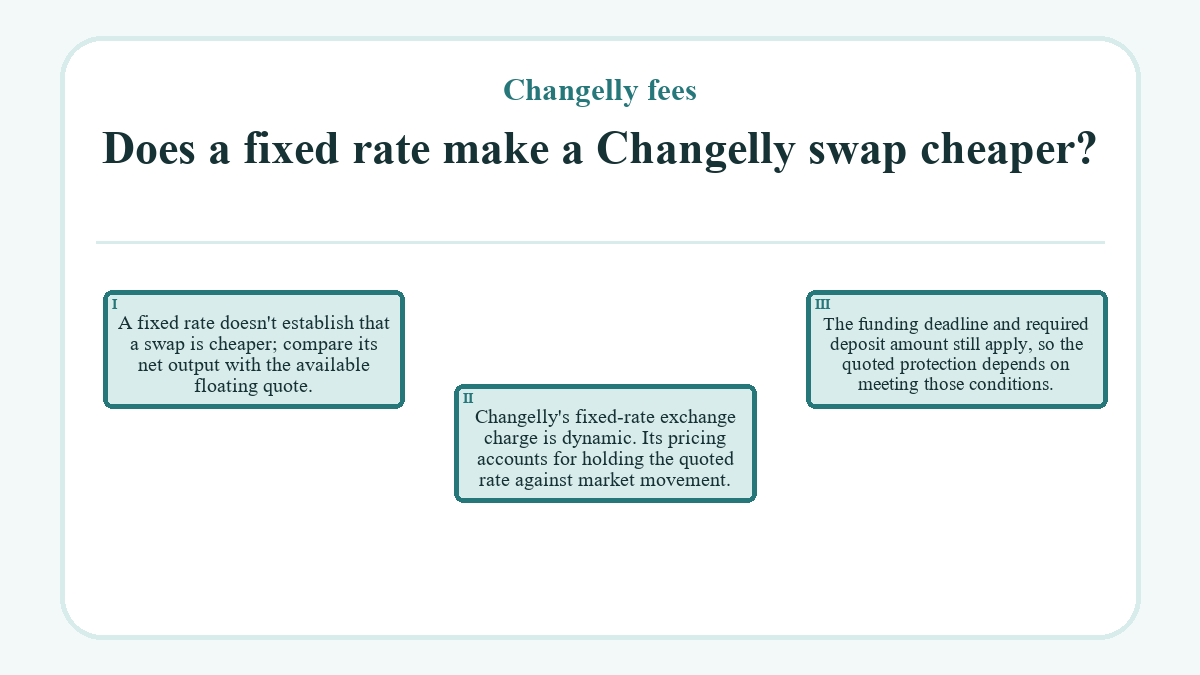
Does a fixed rate make a Changelly swap cheaper?
A fixed rate doesn't establish that a swap is cheaper; compare its net output with the available floating quote. Changelly's fixed-rate exchange charge is dynamic. Its pricing accounts for holding the quoted rate against market movement. The funding deadline and required deposit amount still apply, so the quoted protection depends on meeting those conditions.
A floating quote allows the conversion rate to move during processing. The final amount can therefore change without a corresponding change in the service-fee percentage. Keep exchange-rate movement separate from explicit deductions when reviewing the cost. A fixed quote can suit a requirement for a stated payout, while a floating estimate leaves the eventual conversion price open. Neither label alone identifies the better price.
Compare the net quote with the recorded payout
Use the same total funding budget and receiving asset when comparing offers. Keep the receiving network unchanged, and collect quotes close together so market movement doesn't distort the comparison. A wallet-ready amount already includes its stated deductions. Subtracting them again understates the offer. Raw calculation fields require more care because a field can represent output before the network charge.
Consider a hypothetical cost reconciliation in units of the chosen output asset. A calculation shows 184.72 units before deductions, an exchange charge of 1.12 units, and a payout charge of 0.82 units. The expected net amount is 184.72 - 1.12 - 0.82 = 182.78 units. These are invented arithmetic inputs, not Changelly's fee schedule. A competing offer showing 182.62 units after all deductions delivers 0.16 fewer units, provided both require the same total funding cost.
If the recorded receipt appears smaller than expected, first compare asset quantities rather than the wallet's changing cash valuation. Read the saved quote and payout record without sending another transaction. A receipt of 182.78 units reconciles this calculation. If the quantity still differs, check whether the saved figure was net, whether the order used a floating rate, and whether the final network deduction differed from its estimate. An unexplained difference needs an itemized explanation tied to the exchange ID and payout transaction. The payout record distinguishes estimated output from the amount sent.
Payment providers and DeFi quotes use their own charges
Buying or selling through a payment provider uses that provider's pricing. The standard crypto-swap service percentage doesn't determine the full purchase or sale cost. For a purchase, compare the crypto delivered for the total payment. For a sale, compare the cash payout for the same crypto input, including any separate cost of sending it. The provider's final payment screen gives the transaction-specific breakdown.
Changelly DeFi quotes have a separate fee structure that can include Changelly and affiliate charges. Don't carry a standard exchange percentage into that calculation. Compare the quoted output under the applicable execution conditions, and include any additional transaction expense that the wallet asks you to authorize. A quote that covers one operation doesn't automatically price another operation that requires a separate authorization.
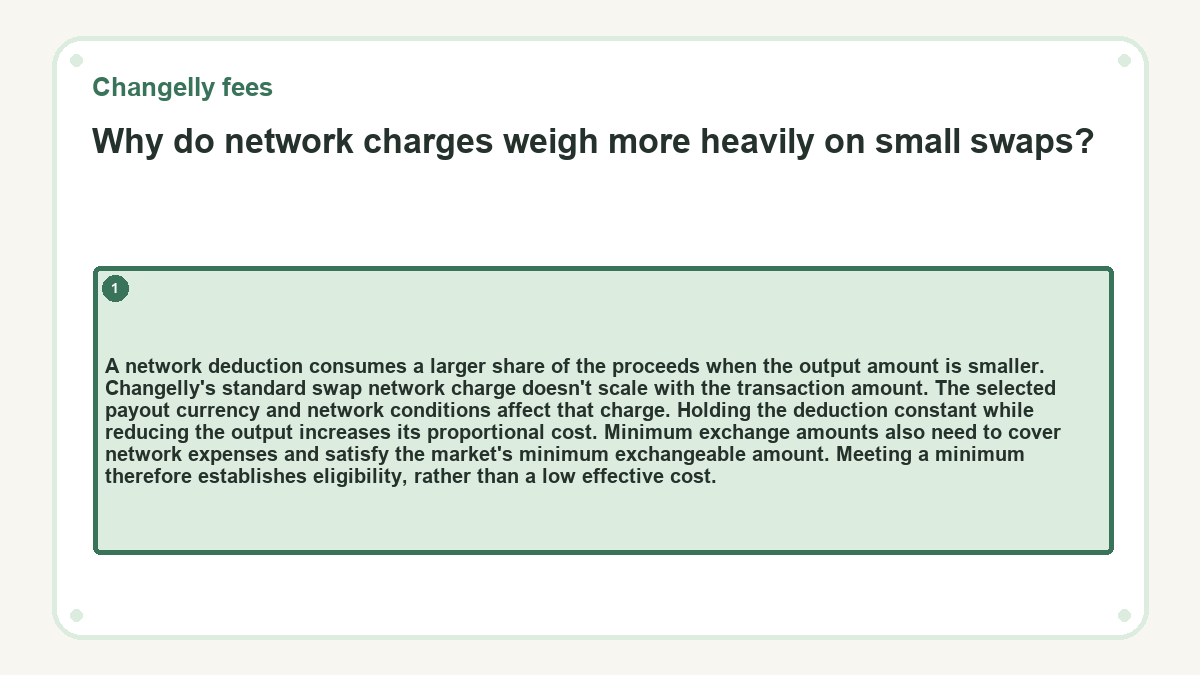
Why do network charges weigh more heavily on small swaps?
A network deduction consumes a larger share of the proceeds when the output amount is smaller. Changelly's standard swap network charge doesn't scale with the transaction amount. The selected payout currency and network conditions affect that charge. Holding the deduction constant while reducing the output increases its proportional cost. Minimum exchange amounts also need to cover network expenses and satisfy the market's minimum exchangeable amount. Meeting a minimum therefore establishes eligibility, rather than a low effective cost.
Refund expenses belong in the final cost record
A refund can return less than the original deposit because applicable network charges and processing expenses may remain. Changelly's terms require your prior consent to deduct operating costs and network fees when refunding funds after resolving misuse-related issues.
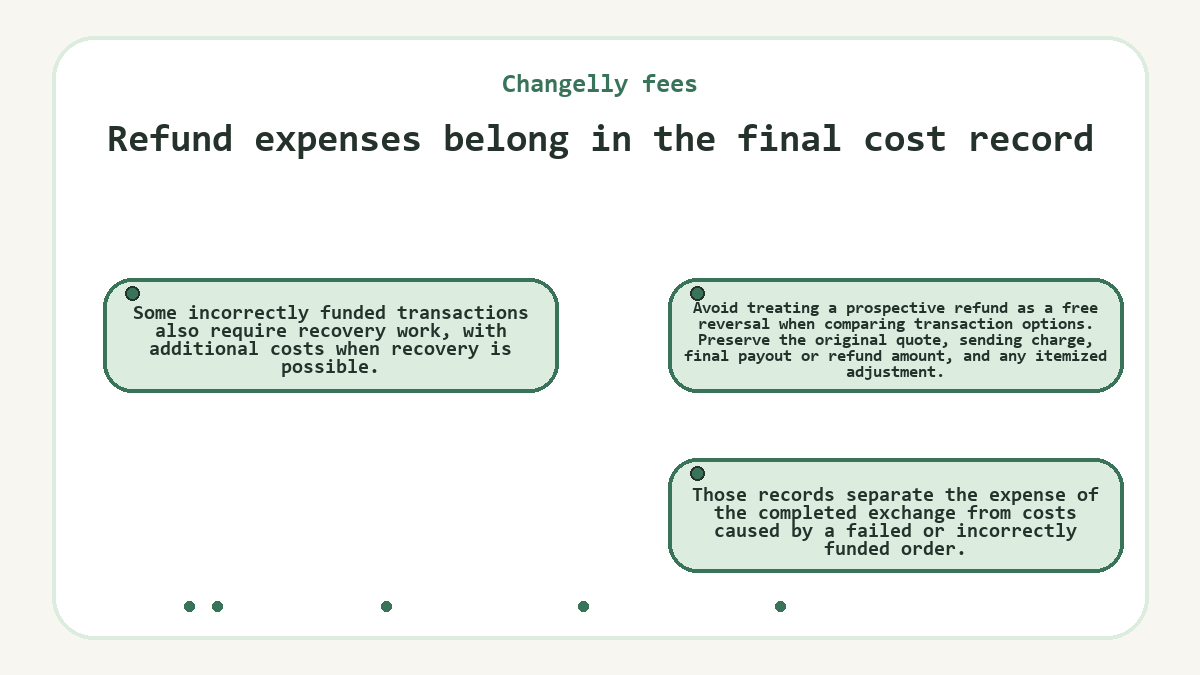
Some incorrectly funded transactions also require recovery work, with additional costs when recovery is possible. Avoid treating a prospective refund as a free reversal when comparing transaction options. Preserve the original quote, sending charge, final payout or refund amount, and any itemized adjustment. Those records separate the expense of the completed exchange from costs caused by a failed or incorrectly funded order.
For another exchange, obtain another quote. A previous receipt describes that completed transaction; it doesn't establish the next network deduction or conversion rate. Apply the same comparison to an alternative service: start with the same funds and end at the same usable destination. An offer with a smaller advertised commission can still deliver less after its conversion price and transfer deductions.
Helpful answers about Changelly fees
-
Does splitting a Changelly swap into smaller orders reduce the total fee?
- Splitting an order doesn't inherently reduce the total cost. Separate swaps can each incur a payout network charge, and funding them can require separate sending charges. Compare the combined net proceeds and total funding expense of the smaller orders with the single-order quote. Each order must also satisfy its own minimum amount.
-
Why can an embedded wallet quote differ from a direct Changelly quote?
- An embedded service can apply an API partner commission. Quote timing and rate selection can also differ, so the difference doesn't automatically equal the partner's fee. Compare matching inputs, receiving networks, and net outputs before attributing the gap to one charge.
-
Can my bank add a currency-conversion cost to a crypto purchase?
- Your bank can apply its conversion rate when the purchase currency differs from your account or card currency. That conversion changes the amount you spend without necessarily changing the crypto provider's quoted fee. Compare the provider's payment currency with your funding currency and include any applicable bank conversion charge.
-
Is the explorer's transaction fee necessarily equal to my quoted network deduction?
- The explorer's transaction fee isn't necessarily the same as your quoted withdrawal deduction. Changelly collects the payout charge through the executing exchange, which sets that withdrawal amount. Compare the deduction with the order's fee record; the blockchain transaction supplies separate evidence of the transfer and its network expense.
-
What does the Exchange API's totalFee field include?
- The Exchange API defines totalFee as the network fee plus the Changelly fee amount. Its fee definitions list the API partner's extra commission separately, so don't assume that totalFee alone represents every expense. It also doesn't capture the external cost of funding the deposit.
Updated on